UK Property Market 2026: What Busy Investors Need to Know
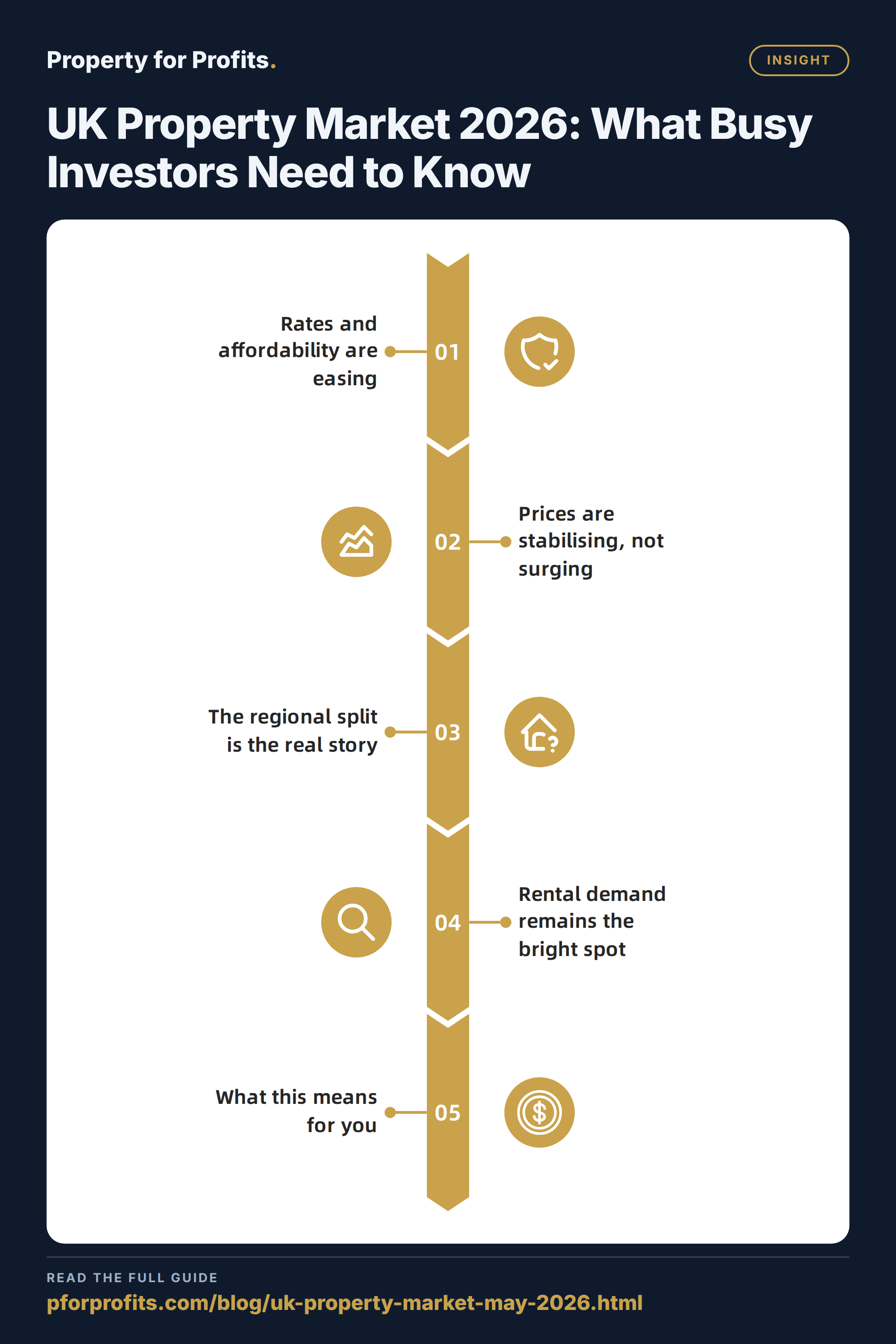
- Mortgage pricing has eased from its peak, lifting cashflow and affordability.
- Prices are broadly stabilising, not surging — buy on income, not hope.
- Affordable regions (North West & Midlands) hold up better than the stretched South East.
- Rental demand stays firm, but rising costs make net yield the number that counts.
If you only have two minutes: the UK market in 2026 is steady, not spectacular. Financing costs have come down from their recent high, prices are moving sideways rather than lurching, and the real story is regional. For a time-poor investor, that favours buying well-priced, cash-flowing stock over betting on quick capital growth.
Everything below is commentary to frame your own research, not a forecast. The figures here are illustrative — the only numbers that matter are the ones attached to the deal in front of you.
Rates and affordability are easing
The defining shift over the past year has been softer mortgage pricing. After a long stretch of elevated rates, lenders have competed harder and fixed-rate products have crept lower. That does two useful things at once: it lowers the monthly cost of holding a property, and it improves what buyers can afford, which tends to put a gentle floor under prices.
Confidence has followed. Transaction volumes feel healthier than during the most uncertain months, and buyers who sat on their hands have started to re-engage. More transactions means more stock changing hands and more motivated sellers — and more chances to buy below market value when a vendor needs speed.
Cheaper money helps your cashflow, but it also brings competition back. The edge goes to whoever buys best, not whoever buys fastest.
Prices are stabilising, not surging
The national headline is stabilisation. Rather than the sharp swings of recent years, values have largely moved sideways, with small monthly wobbles depending on the index you read. For a long-term investor that is arguably the healthiest backdrop there is — it rewards income and value-add over speculation.
In practice, do not underwrite a deal on the assumption that growth will rescue it. If the rent covers the mortgage with a comfortable margin at today's prices, and you have bought at a genuine discount, you are in a strong position whichever way the index ticks next quarter.
The regional split is the real story
National averages hide more than they reveal. The clearest 2026 pattern is the gap between lower-priced regions and the higher-priced South East.
Why the North West and Midlands hold up
Areas across the North West, the North East and parts of the Midlands have generally been more resilient, for one simple reason: affordability. Where a home costs a smaller multiple of local earnings, demand holds up better when money is tight, and rental yields are structurally higher. Rents have not fallen in proportion to lower purchase prices, so the same monthly rent buys a much better gross yield than it would down south.
Where the South East still works
This is not a blanket case against the South. Capital growth potential, tenant covenant strength and exit liquidity can all be stronger in commuter and city locations. The point is to match the strategy to the region: yield-led investing suits more affordable areas, while growth-led or refurbishment-led plays can still make sense in higher-value markets where you are manufacturing equity rather than relying on the market.
Rental demand remains the bright spot
Across almost every region, tenant demand has stayed firm. A shortage of available rental homes, combined with steady demand from people who cannot or choose not to buy, has kept good properties letting quickly. For landlords that supports both occupancy and rent levels — exactly what you want underpinning an income strategy.
The flip side is regulation and running costs. Compliance obligations, energy-efficiency expectations and management overheads keep rising, so the gap between gross and true net yield matters more than ever. Build voids, maintenance, management and insurance into your figures from the start.
What this means for you
- Buy on income, not hope. With prices flat, the rent and the purchase discount protect you — not the assumption of growth.
- Follow the yield. Lower-priced regions generally offer stronger rental returns; match the region to your strategy.
- Stress-test your finance. Rates have eased, but underwrite every deal at a higher rate so a future rise cannot sink you.
- Mind the net, not the gross. Rising compliance and running costs make true net yield the number that counts.
- Source harder. In a flat market, a property found below market value is worth more than any forecast.
A stable, regionally-split market is good news for disciplined buyers. When growth does the heavy lifting, almost anything works and discipline gets punished; when the market is flat, the investors who win are the ones who buy below market value and let strong tenant demand do the rest. Run every opportunity through our deal analyser so cashflow, return and a higher-rate stress test all line up before you commit, and if you want to manufacture a margin rather than wait for one, our guide to below-market-value buying shows where the discounts actually come from.
None of this is a reason to rush. A stable market gives you time to do the work properly: analyse the numbers, verify the rent, check the condition and only commit when the figures stack up at a sensible rate. The headlines will keep swinging between optimism and gloom, but your returns are decided long before any of that — at the price you negotiate and the rent you can prove.