Below-Market-Value (BMV) Buying, Explained in 5 Minutes
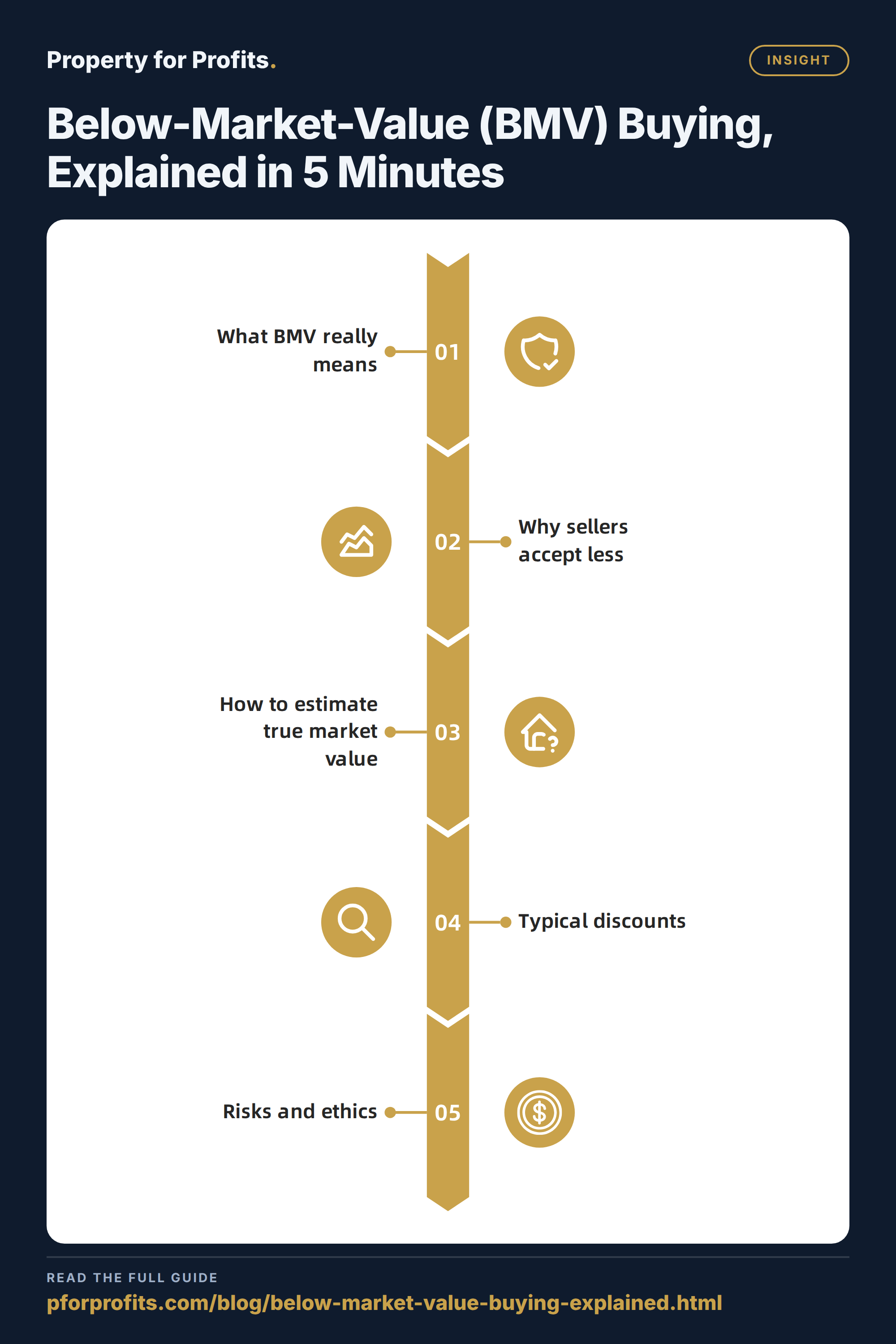
- BMV is measured against true market value, not an inflated asking price.
- Sellers accept less in exchange for speed, certainty or a problem solved.
- Estimate true value from recent comparable sold prices, not asking prices.
- Be honest and transparent — never mislead or pressure a seller in distress.
Buying below market value (BMV) simply means paying less than a property is genuinely worth. The catch — and the whole skill — is that "worth" has to be measured against the property's true current value, not against a hopeful asking price. Get that wrong and a "20% BMV" deal can quietly turn out to be no discount at all.
Here is what BMV really means, why sellers agree to it, how to check the value for yourself, and the lines you should never cross.
What BMV really means
True market value is the price a property would realistically achieve in an open, unhurried sale between a willing buyer and a willing seller. A genuine BMV purchase sits meaningfully below that figure. The asking price is irrelevant to this calculation — it's what the seller hopes for, not what the property is worth.
So the discount you care about is the gap between verified market value and your agreed price. If a property is "on at" £200,000 but truly worth £170,000, paying £160,000 is a real but modest discount — not the headline 20% off the asking price you might be tempted to quote.
Why sellers accept less
Sellers don't give away value for nothing — they trade a little price for something they value more. Usually that's one of three things:
- Speed. A guaranteed quick completion, when waiting isn't an option.
- Certainty. A buyer who won't pull out, gazump or collapse a chain.
- Problem-solving. Relief from a property or situation that's become a burden.
Someone facing repossession, a relationship breakdown, relocation, probate or a collapsed chain may genuinely prefer your fast, certain offer to holding out for the last few percent. For a buyer who can move quickly and complete reliably, that's a fair exchange — not a trick.
You're not paying less because you outsmarted the seller. You're paying less because you're solving a problem the open market can't solve quickly.
How to estimate true market value
Everything rests on getting the value right, and it's not complicated — it just takes honesty.
- Use recent sold prices of genuinely comparable properties — similar size, type, condition and street — not current asking prices.
- Adjust for differences: a tired property needing £30,000 of work isn't worth the same as a refurbished one next door.
- Be conservative. If in doubt, value low. The discount has to survive a sceptical surveyor, not just your own optimism.
Once you have a defensible value, the discount tells you the margin you're buying. From there, run the full picture — rent, costs, stamp duty and a rate stress test — and if you plan to add value and refinance, our BRRR calculator shows how much of your cash a discounted buy could recycle.
Typical discounts
There's no fixed number, and anyone promising a guaranteed percentage is overselling. Discounts vary with the seller's motivation, the local market and how much work the property needs. Modest single-digit discounts are common; larger ones tend to come with a reason — heavy refurbishment, a legal complication or real urgency. Treat any unusually large headline discount as a prompt to dig deeper, not to celebrate.
Risks and ethics
The biggest risk is fooling yourself: anchoring to the asking price, ignoring the cost of works, or believing a seller's or sourcer's valuation without checking. A down-valuation at survey is the market's way of correcting an optimistic figure, so verify everything independently before you commit.
The ethics matter just as much. Offering a fair, fast, certain sale to a willing seller is legitimate and often genuinely helpful. Misleading vulnerable people, misrepresenting value or pressuring someone in distress is not. Be transparent, give sellers room to take their own advice, and never overstate the discount you're offering. The investors with the best long-term reputations are the ones who treat sellers fairly even when they could get away with less.
Where to go next
BMV is the why; sourcing is the how. If you want to know where these discounted opportunities actually come from, read our rundown of the five ways to find below-market deals. Verify the value, buy fairly, and the discount will be real rather than imagined.