Stamp Duty for Additional Dwellings: Working Backwards From Your Budget
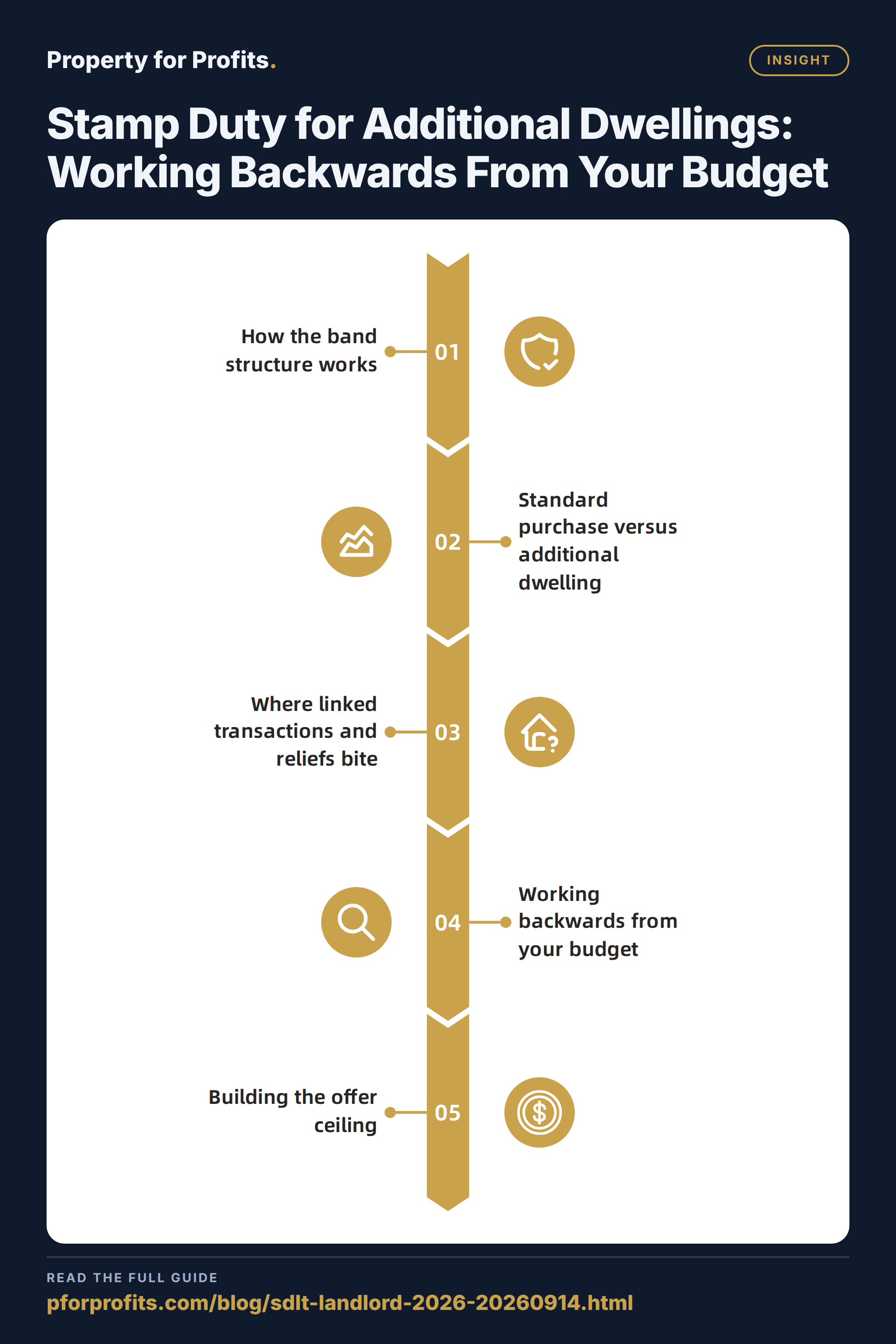
Stamp Duty Land Tax on an additional dwelling is calculated on the whole purchase price using the standard residential bands, plus a surcharge that applies to the portion above the nil-rate threshold for additional properties. Because the surcharge sits on top of the standard calculation rather than replacing it, the tax bill on a second home or buy-to-let is always higher than on a main residence at the same price. Working backwards from your available cash therefore means solving for a price at which deposit, fees and Stamp Duty Land Tax together fit inside your budget.
How the band structure works
Residential Stamp Duty Land Tax is charged in slices. Each slice of the price is taxed at the rate for that band, so the total is not a single flat percentage of the whole price. A purchase that crosses a band boundary pays the lower rate on everything below the boundary and the higher rate only on the excess.
Additional dwellings are treated differently in two ways. First, the surcharge is added to each rate that applies above the additional-dwelling threshold. Second, the threshold at which the surcharge starts is lower than the standard nil-rate band, which means an additional dwelling can attract tax at a price where a main residence would pay nothing.
Reliefs can change the arithmetic. Where a transaction qualifies for relief — for example, certain replacements of a main residence — the additional-dwelling treatment may not apply, or may apply only for a period before a refund is claimed. Whether relief is available depends on the facts of the specific purchase, so the position must be confirmed with the relevant authority for the specific property.
Standard purchase versus additional dwelling
The practical difference is not just the rate. It is the order of operations. For a standard purchase you apply the bands to the price. For an additional dwelling you apply the same bands, then add the surcharge to the slices that fall above the additional-dwelling threshold.
That means the gap between the two treatments widens as the price rises, because more of the price sits in the surcharged slices. It also means the gap is proportionally largest at lower prices, where a standard buyer may pay nothing at all and an additional-dwelling buyer pays the surcharge on the whole amount above the threshold.
Two further points matter for investors. The surcharge is assessed on the transaction, not on the person, so the identity of the buyer and the number of properties they already own can affect the outcome. And where a purchase is linked to another transaction, the linked rules can aggregate the consideration and push the calculation into higher bands.
Where linked transactions and reliefs bite
Linked transactions are purchases that form part of a single arrangement, or that are between the same buyer and seller. When transactions are linked, the consideration is generally aggregated for the purpose of calculating the tax, and the tax is then apportioned. A buyer purchasing two flats in the same building on the same day may therefore pay more than the sum of two separate calculations.
Reliefs work in the opposite direction. A replacement of a main residence can, if the conditions are met, avoid the additional-dwelling surcharge, and a refund may be available where an additional dwelling is sold within the permitted period. These are fact-specific tests, and the deadlines and conditions must be confirmed with the relevant authority for the specific property.
For budgeting, the safe approach is to model the worst case first — full surcharge, no relief, no linking benefit — and then treat any relief as a later adjustment rather than as headroom in the offer.
Working backwards from your budget
Start with the cash you can actually deploy. That is your deposit plus the amount you can borrow, less the costs that are not part of the purchase price: legal fees, survey, lender arrangement fees, and any immediate works. What remains is the maximum price plus the Stamp Duty Land Tax on that price.
The calculation is iterative because the tax depends on the price you are solving for. A workable method is to pick a candidate price, calculate the tax on it, add the two together, and compare with your available cash. If the total is above budget, reduce the candidate price and repeat.
To make the first pass quicker, use the median prices in our sample of public sale-price records held locally, covering 2025-01-01 to 2026-07-31, as reference points rather than as targets. In that sample the median standard market sale was 420,000 for a detached home, 275,000 for a semi-detached home, 240,000 for a terraced home and 230,000 for a flat or maisonette, based on 289,518, 345,864, 324,220 and 185,585 sales respectively. These are medians of standard market sales with non-market transfers excluded, and they are not a guide to what any individual property is worth.
| Property type | Median price in sample | Sales in sample |
|---|---|---|
| Detached | 420,000 | 289,518 |
| Semi-detached | 275,000 | 345,864 |
| Terraced | 240,000 | 324,220 |
| Flat/maisonette | 230,000 | 185,585 |
A simple reverse calculation looks like this. If your available cash for price plus tax is 100,000 and the effective additional-dwelling rate on the relevant slice is 5 per cent, then the maximum price is roughly 100,000 divided by 1.05, or about 95,238. The exact figure depends on which bands the price falls into, so the estimate must be refined band by band.
Do the same calculation at two or three price points around your target. That shows how much of your budget is consumed by tax at each level, and how much room you have to absorb a higher offer without breaching your cash limit.
Building the offer ceiling
Your maximum offer is not the price at which the tax is affordable in isolation. It is the price at which price, tax, and all other acquisition costs fit inside your available funds with a margin for the unexpected.
Set the ceiling at the highest price your cash supports after tax, then subtract a contingency. If the property needs work, or if the survey reveals defects, the contingency is what stops the deal from becoming unfunded.
Where a purchase may be linked to another, run the calculation on the aggregated consideration as well as on the standalone price. The higher of the two is the figure your budget must survive.
What to check next
Confirm the current band thresholds and the additional-dwelling surcharge rates with the relevant tax authority before you make an offer, and check whether any relief applies to your circumstances. Ask your solicitor to confirm in writing how the transaction will be treated, including whether it will be linked to any other purchase.
Obtain a Stamp Duty Land Tax calculation for the specific price you are considering, not for a rounded estimate, and reconcile it against your available cash. Check the public sale-price records for comparable sales in the same area and property type, and verify the property's energy certificate on the energy certificate register.
Finally, confirm your borrowing capacity with your lender and confirm the total of legal, survey and arrangement costs with your solicitor before setting your maximum offer. The figures in this article are sample medians only and are not a substitute for a calculation on the specific property.