Renters' Rights Reforms: What Changed and What Landlords Now Have to Prove
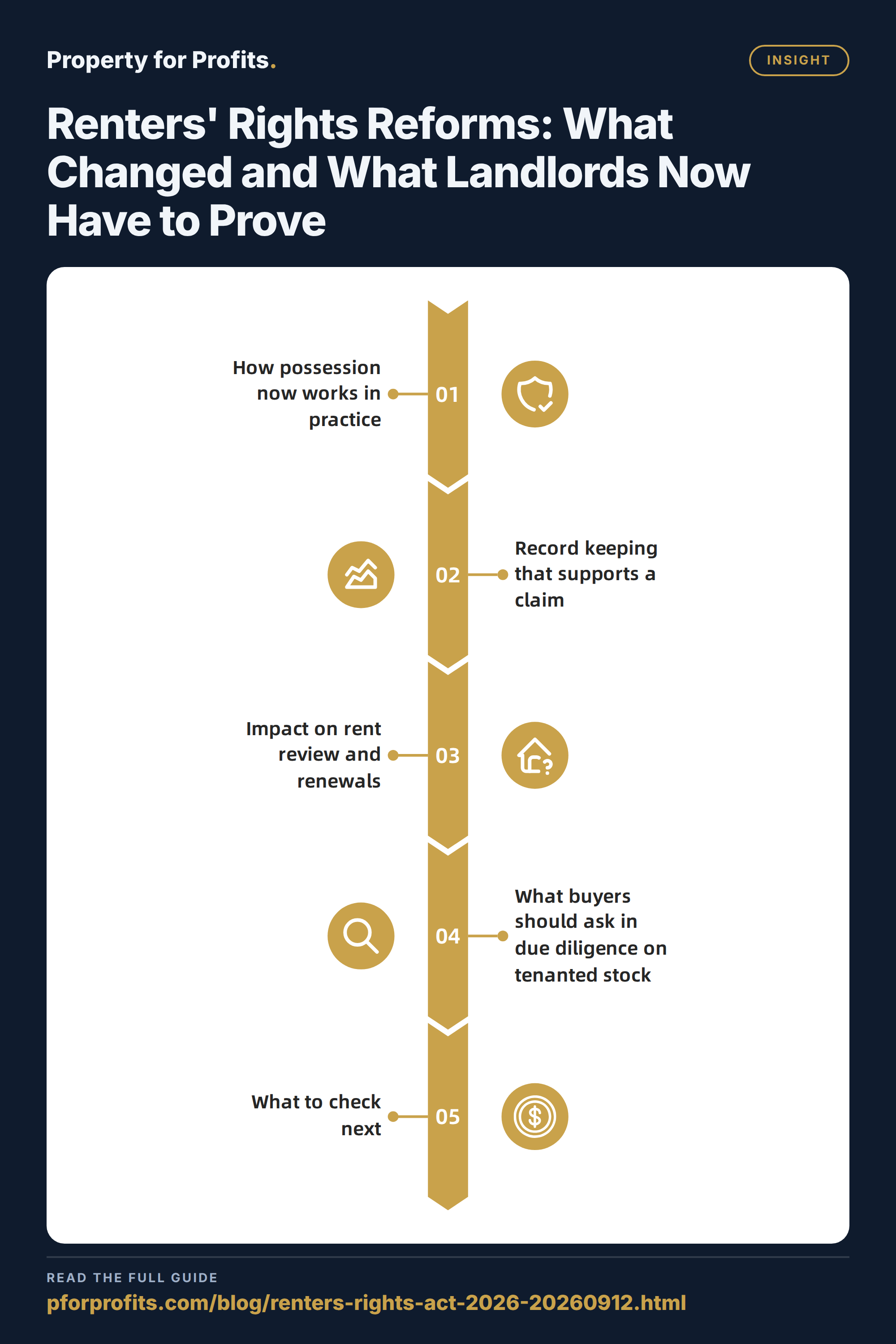
The tenancy framework in England has changed materially, and the practical effect is that possession now depends less on the form of the notice and more on the evidence a landlord can produce. Notice periods, grounds, and the documents that must exist before a claim can proceed have all shifted. The operational consequence is straightforward: landlords and buyers of tenanted stock now need to treat record keeping as a core part of the asset, not an administrative afterthought.
How possession now works in practice
Possession is no longer a single process with a single notice period. It splits into routes that depend on the ground being relied on, and the evidence required differs by route. A landlord must first identify which ground applies, then confirm the notice period and the form of notice that ground attracts, then assemble the supporting documents before serving anything.
For fault-based grounds, the burden is evidential rather than procedural. A landlord has to be able to show the conduct, the breach, or the arrears pattern with dated records that a court can follow. For no-fault routes, the position has tightened around prescribed documents and timing, and the notice cannot be validly served if the underlying paperwork was not in place at the right moment.
The practical sequencing matters. Serving notice before the evidence file is complete creates a defect that is difficult to cure later, and defects in the notice or the preceding documents are the most common reason a claim stalls. The specific grounds available, the notice periods, and the documentary conditions must be confirmed with the relevant authority for the specific property and tenancy before any notice is served.
Record keeping that supports a claim
A possession claim is only as strong as the file behind it. The records that matter are the ones that establish dates, service, and compliance at the point each obligation arose. Undated notes, verbal agreements, and reconstructed timelines do not carry the same weight as contemporaneous documents.
- Tenancy agreement and any variations, signed and dated, with the version history intact.
- Deposit protection evidence, including the prescribed information and the date it was given to the tenant.
- Prescribed documents required before notice can be served, with proof of the date they were provided.
- Gas safety records and the dates they were given to the tenant, not just the dates of the inspection.
- Energy performance and electrical safety documentation, retained with service dates.
- Rent statements and arrears ledgers, showing each payment, each shortfall, and the running balance.
- Correspondence log, recording every contact, warning, and breach notification with dates.
- Proof of service for every notice, including the method used and the date it was deemed served.
The test is whether a third party could reconstruct the timeline from the file alone. If the answer is no, the file is not yet claim-ready. Where a ground depends on repeated conduct or persistent arrears, the ledger and the correspondence log are the two documents that do most of the work.
Impact on rent review and renewals
Rent review and renewal have become documentation events as much as commercial ones. Any increase or new term has to be supported by a compliant tenancy file, because the same records that underpin possession also underpin the enforceability of the terms being varied. A renewal signed on top of an incomplete file carries the same defects forward.
In practice, landlords should treat each renewal as a checkpoint. Confirm the prescribed documents are current, confirm the deposit position is unchanged or correctly re-protected, and confirm the notice and evidence trail for any historic breach is still intact. Where a rent increase is proposed, the mechanism used and the notice given must match what the agreement and the applicable rules allow.
The commercial effect is that renewal conversations now start earlier. A landlord who needs to adjust terms, or who may need possession at some future point, has to plan the paperwork lead time alongside the rent review date. The position on any specific increase or renewal must be confirmed with the relevant authority for that tenancy.
What buyers should ask in due diligence on tenanted stock
Due diligence on tenanted stock is now a documentation audit first and a valuation exercise second. The question is not simply what rent is being paid, but whether the file would support the routes the buyer might need to use. A tenancy that looks straightforward on the rent roll can carry defects that only surface when a notice is served.
| Area | What to request | Why it matters |
|---|---|---|
| Tenancy file | Signed agreement, all variations, and the full document history | Establishes the terms and any defects carried forward |
| Deposit | Protection certificate and prescribed information with dates | Affects the validity of notices and the position on renewal |
| Safety records | Gas, electrical, and energy documentation with service dates | Prescribed documents must be in place before notice |
| Rent ledger | Full payment history and current balance | Supports any arrears-based ground and the rent review position |
| Notices | Copies of any notice served, with proof of service | Reveals whether a route has already been used or exhausted |
| Correspondence | Breach warnings, complaints, and contact log | Provides the conduct evidence for fault-based grounds |
Buyers should also ask what the seller's exit assumption was. If the seller was holding for long-term income, the file may never have been tested. If the seller had considered possession, the file may already contain notices that affect what a buyer can do next.
Where the property is part of a larger block or portfolio, request the same documents for every unit, not a sample. A single defective file can change the operational plan for the whole acquisition, and the cost of reconstructing records after completion is higher than verifying them before.
What to check next
Confirm the current position with the relevant authority for the specific property before relying on any route. Obtain the tenancy agreement, all variations, and the full document history from the seller or the managing agent, and check the dates on each prescribed document against the date notice would need to be served.
Request the deposit protection certificate and the prescribed information, and verify the dates they were given to the tenant. Pull the full rent ledger and reconcile it against the bank statements, then calculate the running balance and any arrears pattern from the primary records rather than a summary.
Ask for copies of every notice ever served on the tenancy, with proof of service, and check whether any route has already been used. Finally, confirm the notice periods and documentary conditions that apply to the grounds you might need, and take advice on the specific tenancy before serving anything or exchanging contracts.