HMO Property Investment UK: A Complete Guide for 2026
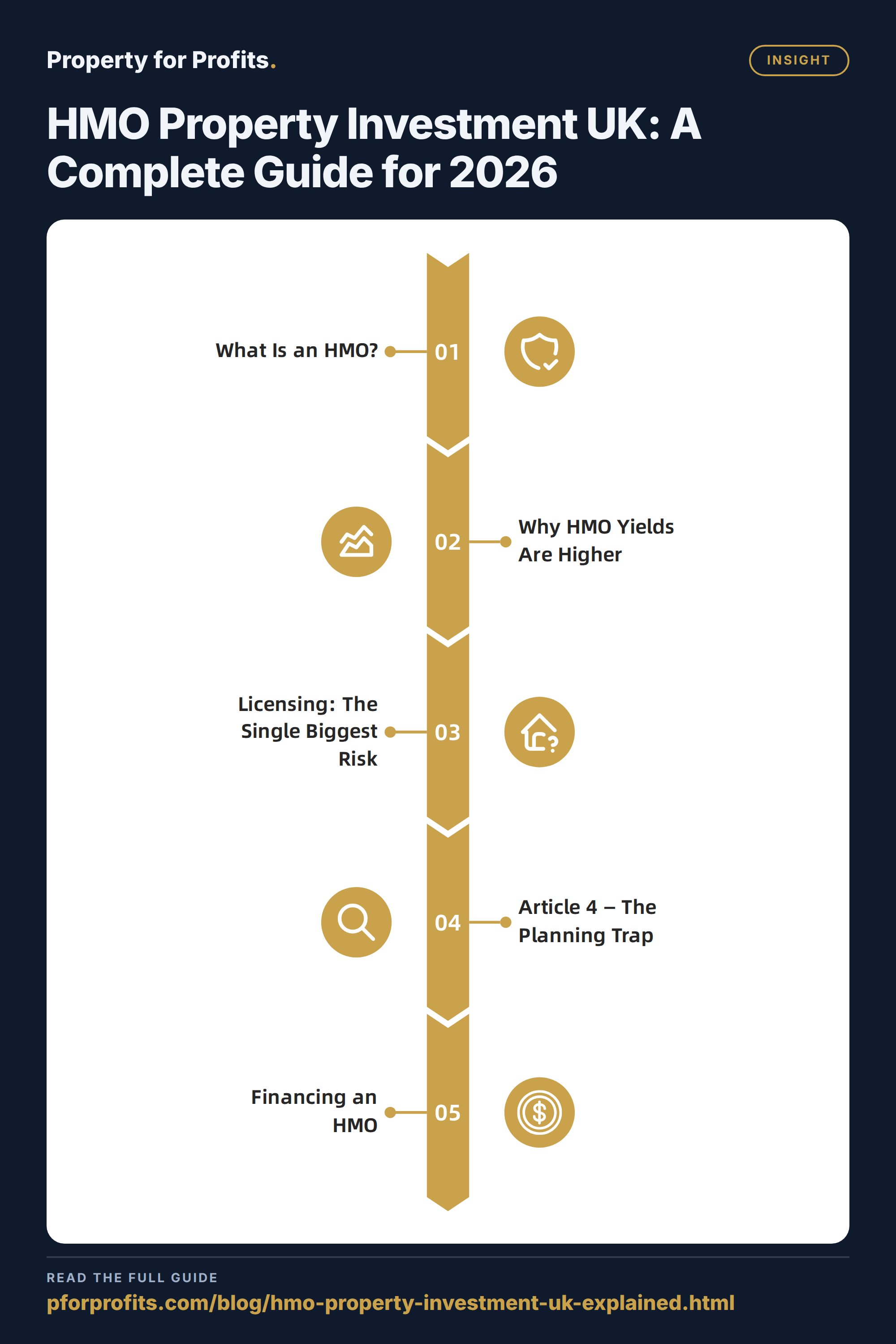
- Gross yields of 10–15% are realistic for a well-located, well-managed HMO.
- Mandatory licensing kicks in at 5+ tenants; many councils also run additional schemes and Article 4 directions.
- Fire safety, amenity standards and planning compliance are non-negotiable — and expensive to retrofit.
- Financing through a limited company is the standard structure for serious HMO investors.
- The best HMO locations balance strong tenant demand with manageable purchase prices and council co-operation.
HMO property investment in the UK is the highest-yielding residential strategy available to private investors — bar none. A standard buy-to-let might nudge 5% gross yield in a good market. A well-run HMO can push past 12%. That premium exists because HMOs are harder to set up, more expensive to finance and more demanding to run than a single-family let.
This guide covers everything you need to know before buying your first HMO — what the regulations actually require, what the numbers look like, where the risks are hiding and how to structure the deal so the yield is worth the work.
What Is an HMO?
Legally, a property becomes an HMO when it is rented to three or more unrelated people who form two or more separate households and share basic amenities (kitchen, bathroom or toilet). The formal definition under the Housing Act 2004 captures most shared houses, flatshares and student lets that meet that threshold.
The regulatory consequences matter more than the label. Once a property qualifies as an HMO, it triggers:
- Mandatory licensing if five or more tenants occupy two or more households
- Minimum room sizes enforced by the local council (typically 6.51m² for a single room, 10.22m² for a double)
- Fire safety requirements including mains-wired smoke alarms, heat detectors, emergency lighting, fire doors and sometimes a fire alarm system
- Waste and amenity provisions that the council can enforce through improvement notices
Why HMO Yields Are Higher
The arithmetic is straightforward. A three-bedroom house let as a single unit in Manchester might produce £1,400 pcm. Converted to a five-bed HMO with en-suites, the same property could generate £650 per room — £3,250 pcm total. That is more than double the rent from the same asset, without doubling the purchase price.
Here is a realistic comparison for a £250,000 property in a Midlands university city:
| Measure | Standard BTL | 5-Bed HMO |
|---|---|---|
| Monthly rent | £1,100 | £2,750 |
| Gross yield | 5.3% | 13.2% |
| Management (12%) | −£132 | −£330 |
| Bills included | £0 | −£400 |
| Net monthly income | £968 | £2,020 |
| Net yield | 4.6% | 9.7% |
The yield gap narrows once you factor in higher finance costs, refurbishment spend and void risk, but HMO still wins on cash-on-cash return by a significant margin — provided the regulatory box is ticked from day one.
Licensing: The Single Biggest Risk
HMO licensing is not a tick-box exercise. It is a criminal offence to operate a licensable HMO without a licence, and the penalties are severe — fines of up to £30,000 per property, Rent Repayment Orders (requiring you to repay up to 12 months of rent) and a Banning Order that can prevent you from letting property altogether.
There are three types of licensing to understand:
- Mandatory licensing — applies nationally to any HMO with 5+ occupiers forming 2+ households. The licence lasts 5 years and costs anywhere from £500 to £1,500 depending on the council. It sets minimum room sizes, requires the property to be "reasonably suitable" for occupation and demands annual gas safety, EICR certificates and working smoke alarms.
- Additional licensing — councils can designate specific areas where smaller HMOs (3–4 tenants) also need a licence. These schemes typically last 5 years and mirror the mandatory conditions.
- Selective licensing — covers all private rented properties (including single-family lets) in designated areas. Not HMO-specific, but it adds compliance overhead if you own property in a selective zone.
More than 80 councils in England now operate additional or selective licensing schemes, and the number is growing. Always check your local council's housing enforcement page before making an offer. The cost of retrospective compliance can wipe out a year of profit.
Article 4 — The Planning Trap
An Article 4 direction removes the permitted development right to change a property from a single-family dwelling (C3 use class) to a small HMO (C4, 3–6 unrelated tenants). Where Article 4 is in force, you need full planning permission to create a new HMO.
This matters because most investors buy a standard house with the intention of converting it. If the property sits in an Article 4 area — and the majority of major UK cities including London, Manchester, Birmingham, Nottingham, Leeds and Bristol have them — you cannot convert without planning consent.
How to handle Article 4:
- Check the council's local plan and Article 4 map before viewing any property
- If the property already operates as an HMO, check that it has an existing lawful use certificate or established use — a property sold with vacant possession loses its HMO use class if empty for more than a few months
- Budget 3–6 months for a planning application if you need one, and accept that it may be refused on amenity, parking or over-concentration grounds
Financing an HMO
High-street buy-to-let mortgages rarely cover HMOs. You need a specialist HMO mortgage, and the criteria are tighter:
- Loan-to-value: Typically 70–75% max (versus 75–80% for standard BTL)
- Interest rates: 1–2 percentage points higher than a vanilla BTL product
- Rental cover: Lenders usually require 145–160% interest coverage ratio (ICR), compared with 125% for single-lets
- Minimum rent: Many HMO lenders require a minimum rental income of £25,000–£30,000 per year
Most serious HMO investors operate through a limited company — as with standard BTL, this gives access to lower rates and removes the section 24 tax restriction that penalises higher-rate individual landlords. Speak to a mortgage broker who specialises in HMO finance before you start looking for properties.
Fire Safety and Amenity Standards
Fire safety in HMOs is governed by the Regulatory Reform (Fire Safety) Order 2005 and the council's licensing conditions. The minimum across virtually all schemes includes:
- Mains-wired smoke alarms in every circulation space and at least one per floor level
- Heat detectors in kitchens (where smoke alarms would false-alarm)
- Fire doors to every bedroom — self-closing, intumescent strips and cold smoke seals
- Emergency lighting in common areas for properties with 5+ occupiers
- Fire blanket in the kitchen, and a fire extinguisher on each floor (in most council schemes)
- Annual gas safety check and periodic electrical inspection (EICR) every 5 years
A full HMO fire-safety retrofit on a typical Victorian terrace can cost £8,000–£15,000 depending on the number of rooms and the existing door specification. Factor this into your purchase budget — it is not optional.
Running the Numbers
Before you commit, stress-test the deal. Use our Deal Analyser and Rental Yield calculator to check the figures, but add these HMO-specific costs to your model:
- Void allowance: Budget 8–12% for room voids. With multiple tenants, you rarely have 100% occupancy. A single room empty for three weeks costs you £150–£200 in lost rent.
- Council tax liability: If a room is empty you are liable. Student HMOs are council-tax exempt; professional HMOs are not.
- Utilities: Most HMOs are let bills-included. Cap the contract and set a realistic monthly utility budget — energy prices have added £80–£120 per month to typical HMO running costs since 2022.
- Management: HMO management fees run 10–15% of gross rent, and full-management (finding tenants, collecting rent, dealing with maintenance) is the norm unless you self-manage.
- Refurb contingency: Add 15–20% on top of the refurb quote — HMO conversions almost always reveal unexpected work during the build.
An HMO that looks brilliant on gross yield can turn cash-flow negative after costs if you do not budget for the full picture. Calculate net yield, not gross.
Best Locations for HMO Investment in 2026
The best HMO markets balance three factors: strong tenant demand, manageable purchase costs and a council that is willing to licence rather than oppose new HMOs. Current hotspots include:
- University cities (Nottingham, Leicester, Sheffield, Liverpool) — steady student demand, large existing HMO stock and councils that understand the market, though Article 4 is nearly universal. Student HMOs tend to have lower void risk but higher wear and tear.
- Commuter belt towns (Wolverhampton, Stoke-on-Trent, Derby) — lower entry prices (£80K–£140K for a 3-bed terrace), growing professional tenant demand and fewer licensing schemes, though this is changing rapidly.
- Northern regeneration areas (Hull, Middlesbrough, Sunderland) — very low purchase prices (£40K–£80K for terraced stock) with gross yields that can exceed 15%, but thinner tenant demand and longer voids.
Our view: the sweet spot for first-time HMO investors in 2026 is a 5–6 bedroom property in a mid-sized university city, priced between £180K–£280K, in a street with existing HMO neighbours and no active opposition from the planning department.
When HMO Investment Is Not Worth It
HMO investment does not suit every landlord or every property:
- If you want a passive investment, buy a single-let. HMOs are active investments — tenant turnover, maintenance calls and compliance updates happen every month, not once a year.
- If the property needs a full planning application for change of use, do not pay a premium for it. The planning risk belongs to the seller unless the price reflects the uncertainty.
- If the gross yield is under 9% after factoring in the HMO premium you paid over a standard house, the numbers do not work. HMO buyers often bid 10–20% above market value for a "ready-made" HMO — that kills the yield before you start.
- If you cannot cover three months of mortgage payments from savings, build that buffer first. HMO voids can cluster — three rooms empty simultaneously during a student summer is common and can be expensive.
HMO vs Other Property Strategies
How does HMO stack up against the other strategies on our site?
- BRRR — BRRR aims to recycle capital; HMO aims to maximise income. They are complementary: buy an HMO cheap, refurbish and refinance (BRRR), then keep it for the high cashflow. Many experienced investors run HMOs inside a BRRR framework.
- Buy-to-let — Standard BTL is simpler, less regulated and easier to finance, but yields half what a comparable HMO delivers. Choose BTL for low-maintenance portfolio growth; choose HMO for income.
- Serviced accommodation — Holiday lets deliver even higher per-night rates than HMOs but with seasonal volatility and full-furnish cost. HMOs are the middle ground: better cashflow than BTL, less operational intensity than serviced.
- Rent-to-rent — Rent-to-rent HMOs (leasing a property from a landlord and sub-letting room-by-room) reduce capital requirements but add legal complexity and thinner margins. See our lease options guide for the legal framework.
Final Word
HMO property investment in the UK is not a shortcut — it is a higher-effort, higher-reward strategy that rewards preparation over enthusiasm. The investors who succeed in 2026 are the ones who budget for compliance costs before writing the offer, stress-test the net yield at realistic void rates and choose a broker who understands HMO finance before they start viewing properties.
The margin between a great HMO deal and a painful one is usually just a few thousand pounds of licensing, fire safety or void cost that was either planned for or not. Plan for it.