Development Finance in the UK: Costs, Timelines and What Lenders Check
Development and conversion finance looks simple from a distance — borrow, build, refinance or sell — but the cost structure and lender checks decide whether a scheme works. This guide breaks down the numbers and the process using standard 2026 market parameters.
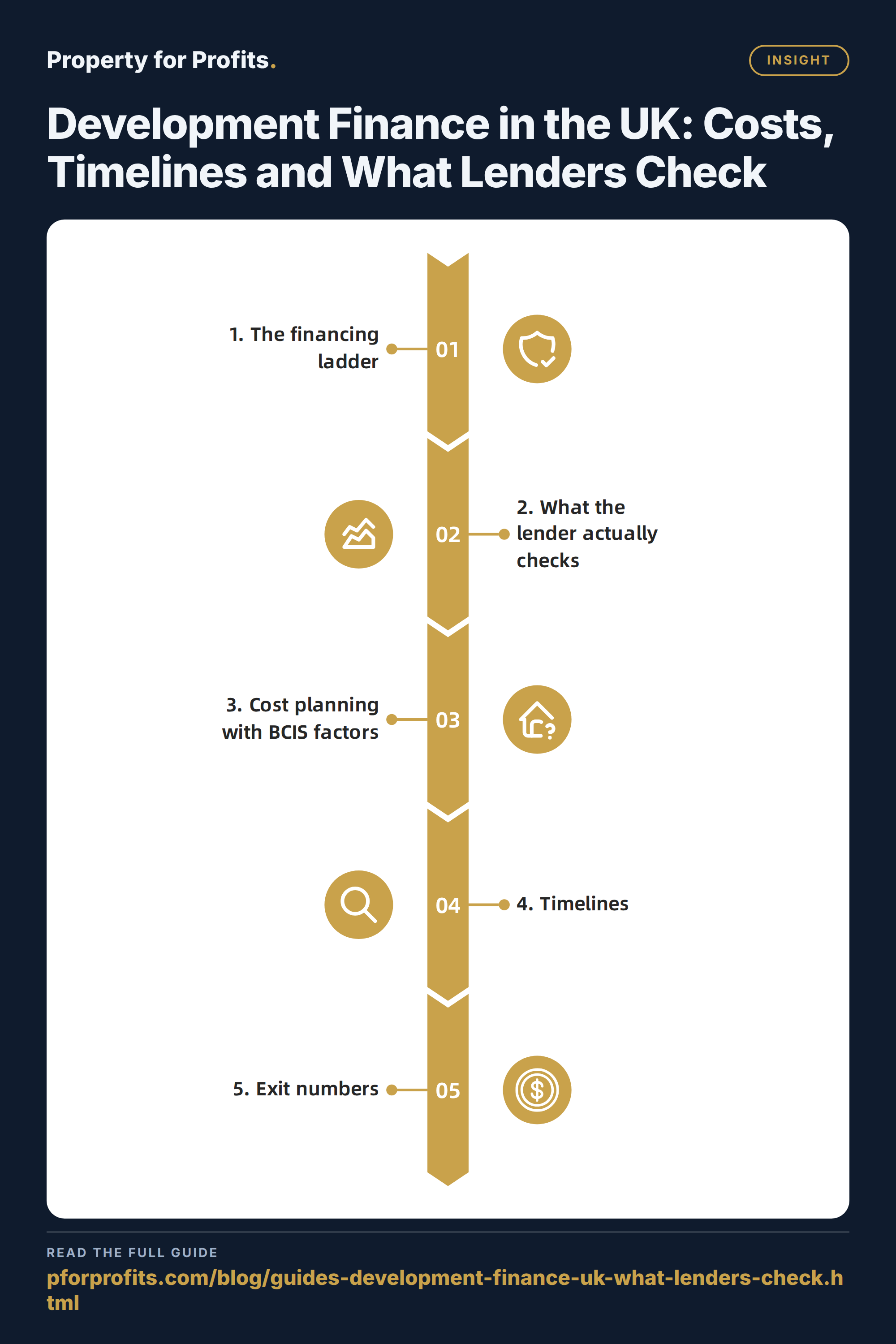
1. The financing ladder
Most conversions use two products in sequence. Bridge finance covers the purchase and the works: 0.6%–0.9% per month, typically 60%–75% of purchase price with the works funded on top, capped at a percentage of the end value. On completion, either the asset is sold (exit through sale) or refinanced onto a long-term mortgage (exit through refinance) — in which case the lender revalues at the post-works market value, not the purchase price.
Development finance for ground-up or larger schemes is staged: funds release against valuations at each phase, with margins of 0.85%–1.25% per month reflecting construction risk.
2. What the lender actually checks
Lenders underwrite four things. First, the exit: they apply a stress discount to the projected end value — commonly 70%–80% of GDV — and require the full loan, rolled interest and exit fees to sit under it. Second, the borrower: experience, liquidity, and a documented exit route. Third, the cost plan: an itemised budget with contingency (typically 10%–15% of build cost). Fourth, the market: comparable evidence that the end value is supportable, not just estimated.
3. Cost planning with BCIS factors
National average build and refurbishment costs are adjusted by BCIS location factors. London boroughs run 1.08–1.22, the South East around 1.04, the East 1.00, the South West 0.97, the East Midlands 0.93, the West Midlands 0.94, Yorkshire 0.91, the North West 0.95, the North East 0.88, Wales 0.94 and Scotland 0.97. Applying the wrong factor is a common source of budget error — a £30,000 refurbishment in the North East costs roughly £38,000 in inner London before any spec differences.
Itemised budgets matter more than totals. A realistic 3-bed refurbishment budget at mid-market rates itemises roughly: kitchen £5,000–£7,000, bathroom £3,500–£4,500, rewiring £2,500–£4,000, plastering £2,000–£3,000, flooring £3,000–£4,500, windows and doors £5,000–£8,000, heating £3,000–£4,500, decorating £1,500–£2,500, externals £1,000–£2,000, plus 5%–10% contingency. Itemising is what lets a scheme survive a cost overrun — and most schemes have one.
4. Timelines
Planning, where required, typically adds 8–13 weeks for a delegated decision (officer-level) — and most councils now delegate the majority of applications. On site, a residential conversion or refurbishment runs 12–20 weeks: strip-out and structural works, first fix, wet trades, second fix, decoration and certification. Every week of slippage costs the bridge interest on the full facility, so the holding-cost line in the appraisal should be built from the timeline, not guessed.
5. Exit numbers
The exit is where schemes succeed or fail. On a sale exit, allow 2%–3% of the end value for selling costs. On a refinance exit, the loan is sized to the post-works value at the lender's LTV — commonly 75% — and the equity recovered is the difference between the end value and the refinance loan. That recovered equity, not the headline profit, is the cash that funds the next deal.
The discipline is simple to state and hard to keep: itemise the costs, apply the regional factor, stress the exit, and count the holding period in weeks with the interest attached.