Renters' Rights Act 2025: What UK Landlords Must Know
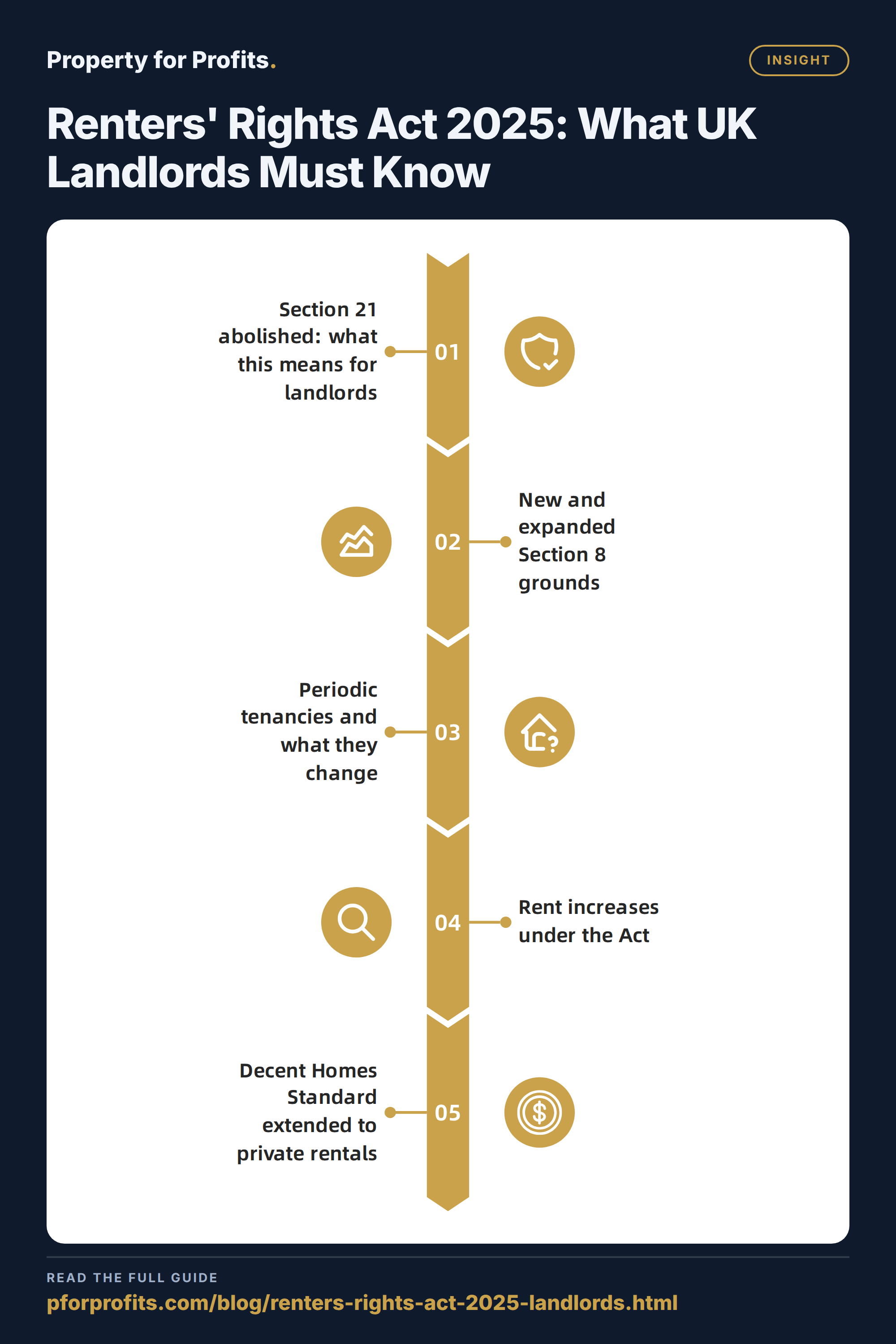
- Section 21 abolished — all tenancies are now periodic; no more fixed-term ASTs in the traditional sense.
- Section 8 grounds expanded — new Ground 1A (sale of property) plus strengthened Grounds 1, 6, 8 and 11.
- Rent increases limited to once per 12 months, with prescribed form and tribunal challenge rights for tenants.
- Renters' Rights Act compliance requires registration on the new Private Rented Sector Database.
- The Decent Homes Standard now applies to private rentals — local authorities have enhanced enforcement powers.
The single most consequential change to the private rented sector in decades took effect on 1 May 2026: the complete abolition of Section 21 no-fault evictions in England. From this date, landlords can no longer evict tenants without providing a valid reason under Section 8 of the Housing Act 1988.
This change applies to every assured shorthold tenancy in England, both new and existing. Every tenancy is now effectively periodic — running indefinitely until either party ends it under the prescribed grounds. Fixed-term ASTs in their traditional form are gone. The government's stated aim is a fairer, more stable rented sector, but the practical implications for landlords and investors are significant.
Below is a practical breakdown of every major provision in the Act and how to adapt your portfolio and processes.
Section 21 abolished: what this means for landlords
Section 21 was the most commonly used eviction route for landlords who simply wanted their property back at the end of a tenancy, with no reason required. Its removal means every possession claim must now be based on one of the expanded Section 8 grounds, each of which requires specific evidence and carries longer notice periods.
The biggest practical change is that tenant selection is now the most critical risk-control measure in your portfolio. Without the safety net of no-fault eviction, getting referencing right on the front end — employment verification, previous landlord references, affordability checks at 30% of income minimum — becomes non-negotiable. Landlords who skimped on vetting because they could fall back on Section 21 will need to tighten up immediately.
Notice periods have also increased across the board. Most Section 8 grounds now require two to four months' notice, compared to the two-month Section 21 notice that previously applied. This means the eviction process, from serving notice to gaining possession, now takes longer even when you have strong grounds. Plan for a minimum of four to six months from the first sign of trouble to vacant possession.
New and expanded Section 8 grounds
The government has strengthened several existing grounds and introduced new ones to give landlords clear pathways to regain possession. Understanding each ground and its evidence requirements is essential for operating under the new regime.
Ground 1 — owner occupation
Landlords can still reclaim possession if they or a close family member intend to move into the property. The notice period is now four months, and the landlord must have owned the property for at least 12 months before serving notice. Misuse of this ground — taking possession without genuinely occupying — carries penalties including compensation equivalent to up to 12 months' rent. Document your intention to occupy clearly and keep records.
Ground 1A — sale of property (new)
A new ground allowing possession when the landlord intends to sell the property. Requires four months' notice and a genuine intention to market and complete a sale. This replaces the informal practice of asking tenants to leave during or after a fixed term. If you are planning to exit a property, serve notice under Ground 1A early and start marketing — the process is slower than the old Section 21 route.
Ground 6 — redevelopment
Strengthened to allow possession when a landlord intends to carry out substantial refurbishment that cannot reasonably be done with the tenant in situ. Requires two months' notice and, where applicable, a statutory decant offer — the right for tenants to return to the refurbished property at the same rent once work is complete. This is particularly relevant for investors doing BRRR-style renovations on tenanted properties.
Ground 8 — rent arrears
The mandatory possession threshold remains at two months' rent arrears (eight weeks for weekly tenancies). However, the court process now includes an expectation that landlords have engaged with the tenant's financial circumstances before proceeding. Keep records of all communications about payment plans, Universal Credit claims, or other financial support the tenant has sought. The court will consider whether you made reasonable efforts to resolve the arrears before seeking possession.
Ground 11 — persistent late payment
This discretionary ground has been strengthened. Courts are now instructed to consider the pattern of late payments, not just the overall arrears balance. A tenant who pays the full amount each month but always two weeks late can be evicted under Ground 11, even if they are never technically in arrears at the point of payment. Maintain a clear rent payment schedule showing every date each payment was received.
Periodic tenancies and what they change
Every AST in England is now a periodic tenancy by default. There are no more fixed terms that automatically end on a specific date. The tenancy continues indefinitely until either party ends it through the correct legal process.
For landlords, this means you cannot simply wait for a fixed term to expire and ask the tenant to leave. You must have a valid Section 8 ground and serve the correct notice period. For tenants, it means they have greater security of tenure — they cannot be forced out by a fixed-term expiry date alone.
The practical effect is that void periods and tenant turnover will likely decrease, because tenants feel more secure and stay longer. This is positive for cash flow but means you need to be more selective about who you let to in the first place. A bad tenant who previously would have been removed at the end of a six-month fixed term could now stay for much longer if you do not have the grounds or evidence to remove them.
Rent increases under the Act
Landlords can increase rent once every 12 months using the prescribed form (Form 6B or equivalent). The increase must reflect the market rate — it cannot be punitive or designed to force the tenant out. Tenants can challenge the increase at the First-tier Tribunal (Property Chamber), which will assess whether the proposed rent is in line with comparable local properties.
The Tribunal has powers to reduce a proposed increase if it finds the amount unreasonable or motivated by a desire to circumvent the new possession rules. In practice, this means annual rent increases should be clearly documented and benchmarked against local market data. If you are raising rent significantly above local comparables, expect a challenge and prepare your evidence.
For landlords in the West Midlands, where rental growth has been strong — Birmingham rents rose 8-10% year-on-year in 2025 — modest annual increases in line with local market movements should face few challenges. The key is to move early and incrementally rather than playing catch-up with a large jump after several years of static rent.
Decent Homes Standard extended to private rentals
For the first time, the Decent Homes Standard — previously a social housing requirement — now applies to the private rented sector. Every rental property must meet minimum standards of repair, heating, and safety. Local authorities have enhanced enforcement powers, including compliance notices and financial penalties of up to £30,000 without going to court.
This is particularly relevant for HMO landlords and investors buying below-market-value properties that need significant refurbishment. The standard requires adequate thermal comfort (insulation and heating), a reasonable state of repair (no Category 1 or 2 hazards under HHSRS), and reasonably modern facilities and services. If your property needs significant work, ensure the refurbishment brings it to this standard before the first tenant moves in.
PRS Database — mandatory registration
A new Private Rented Sector Database has been established, and all landlords with properties in England must register. The database creates a central compliance record linking each property's condition, the landlord's identity, and any enforcement actions taken against them. Registration is mandatory, and non-compliance carries civil penalties.
The database is designed to make it harder for rogue landlords to operate by creating a transparent, searchable register. Local authorities, tenants, and mortgage lenders will all have access to relevant information. For professional landlords with compliant properties who maintain good records, this is a non-event — register, keep your details current, and move on.
Compliance checklist for every landlord
To operate effectively under the new regime, complete the following actions on every property in your portfolio:
- Register on the PRS Database — mandatory. Submit landlord details, property addresses and compliance status.
- Review all tenancy agreements — replace fixed-term AST clauses with periodic tenancy terms. Remove any references to Section 21.
- Update rent review clauses — align with the 12-month cycle and prescribed notice format (Form 6B).
- Strengthen tenant referencing — implement comprehensive checks: right-to-rent, affordability (30% of income minimum), previous landlord references, employment verification.
- Document everything — maintain clear records of rent payments, correspondence, inspections and compliance certificates. These will be critical if you need to rely on Section 8 grounds.
- Audit property conditions — ensure every property meets the Decent Homes Standard. Address any Category 1 or 2 hazards.
- Review deposit protection — deposits must be protected within 30 days with prescribed information served correctly. Non-compliance can now block Section 8 possession claims.
What this means for property investors
The Renters' Rights Act is not a threat to the buy-to-let sector, but it does demand a higher standard of professionalism. Landlords who operate compliant properties, select tenants carefully and maintain good records will continue to perform well. Those who relied on Section 21 as a safety net for poor tenant selection or substandard conditions will find the new regime challenging.
For BRRR and BTL investors, the key implications are straightforward: refurbishment quality matters more because the Decent Homes Standard applies from day one; tenant retention becomes a valuable asset because good tenants who stay reduce the risk and cost of possession; and portfolio compliance is a competitive advantage — landlords with clean databases and documented histories will navigate Section 8 grounds more easily.
The Midlands market — particularly Birmingham, the Black Country, and the wider West Midlands — remains attractive for buy-to-let. Strong rental demand driven by population growth and limited housing supply, combined with more affordable entry prices than the South East, creates favourable conditions even under the new rules. The key is to build compliance into your acquisition strategy rather than treating it as an afterthought. Run every potential deal through our deal analyser to model cash flow with the longer void periods and tenant retention assumptions the new regime creates.